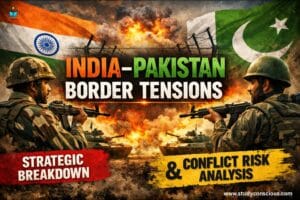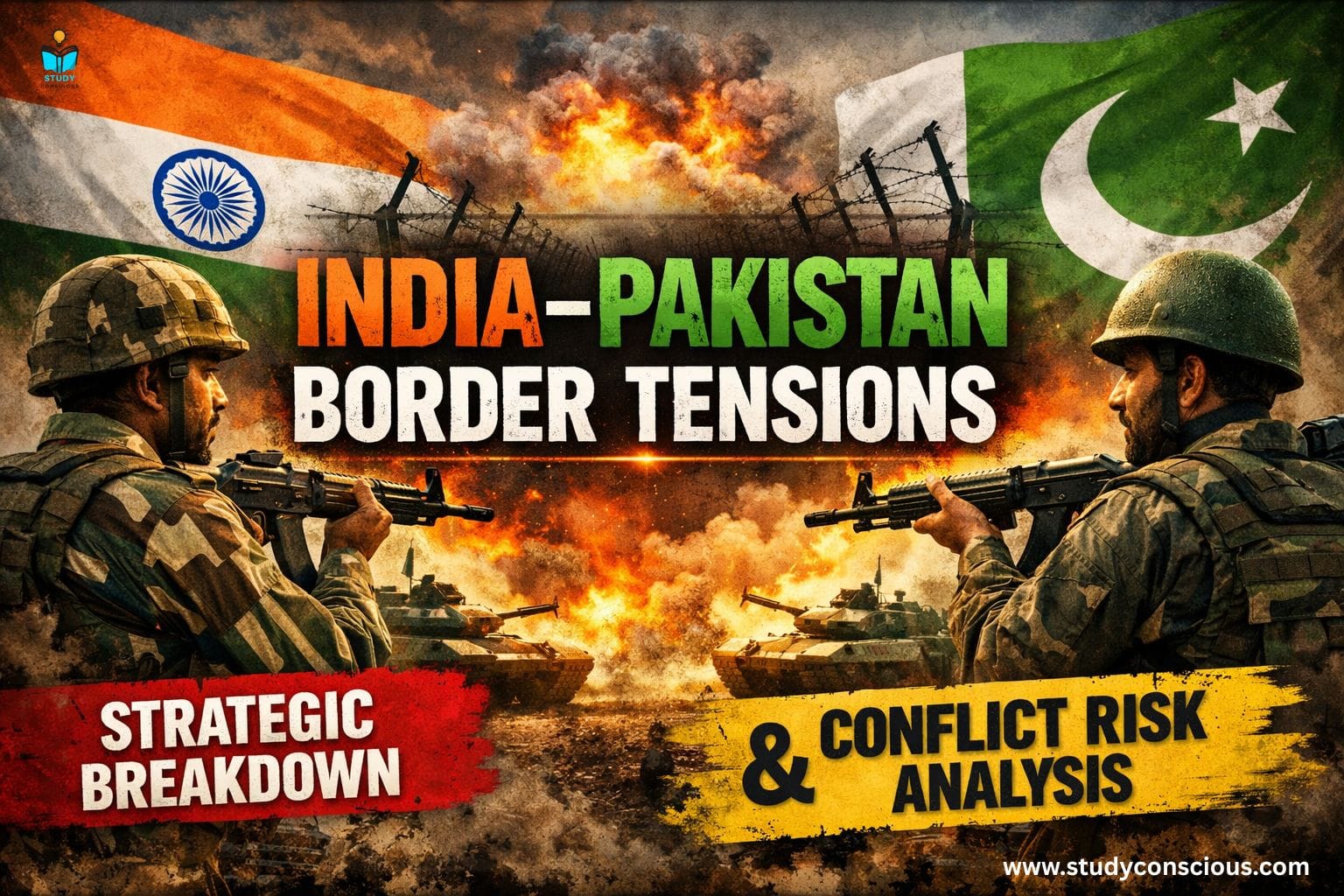
The tensions on the India-Pakistan border are again in the spotlight. There have been reports of enhanced military movements, surveillance activities, and strategic positioning, which have led to an important question being asked:
🌍 Diplomatic & Global Angle
Internationally:
- Major powers prefer stability in South Asia.
- Both nations are nuclear-armed, which acts as a strong deterrent against full-scale war.
- Backchannel diplomacy and military hotlines remain active tools to prevent escalation.
Global economic priorities and regional stability concerns make a prolonged conflict unlikely in the short term.
🔎 Could This Escalate into a Major Conflict?
Here’s a realistic assessment:
🔴 Factors That Could Escalate:
- A major terror incident traced across the border
- Significant civilian or military casualties
- Political pressure domestically
🟢 Factors Preventing Full-Scale War:
- Nuclear deterrence
- Economic constraints
- International diplomatic pressure
- Existing ceasefire mechanisms
Historically, tensions have resulted in limited tactical responses, not prolonged wars.
📊 Possible Future Scenarios
- Controlled Tension – Increased troop movement but no major clashes. (Most likely)
- Limited Strike / Retaliation – Short, contained military action.
- Extended Conflict – Highly unlikely unless triggered by a large-scale provocation.
🎯 Strategic Conclusion
At present, the situation appears more like strategic signaling rather than imminent war preparation. Both sides are demonstrating strength while avoiding steps that could trigger uncontrollable escalation.
South Asia remains sensitive. But based on current indicators, a full-scale war is not the most probable outcome.
📌 Key Topics Covered: India–Pakistan Border Tensions Explained
1️⃣ Latest India–Pakistan Border Updates
Recent reports indicate increased troop vigilance and surveillance along the Line of Control (LoC) and sensitive sectors of the international boundary.
While no full-scale engagement has been reported, defensive positioning and monitoring have intensified.
2️⃣ Reasons Behind Rising Tension
Key factors contributing to the current situation:
- Infiltration alerts
- Political rhetoric on both sides
- Cross-border ceasefire violation concerns
- Regional security developments
Border dynamics in this region are often reactive and strategic rather than immediately offensive.
3️⃣ Military Preparedness of Both Nations
- The Indian Army maintains high-altitude deployment and surveillance systems in forward areas.
- The Pakistan Army also sustains forward defensive readiness.
Both countries possess conventional as well as strategic deterrence capabilities, making escalation calculations complex.
4️⃣ Diplomatic & Strategic Implications
- Military hotlines and ceasefire mechanisms are still operational.
- Global powers prefer de-escalation due to nuclear risk.
- Backchannel diplomacy often plays a silent but important role.
Strategically, signaling strength is common — but full conflict carries high cost.
5️⃣ Historical Background of India–Pakistan Conflicts
Major past wars and conflicts include:
- Indo-Pakistani War of 1947–1948
- Indo-Pakistani War of 1965
- Indo-Pakistani War of 1971
- Kargil War
Since 1999, tensions have largely resulted in limited engagements rather than prolonged conventional wars.
6️⃣ Impact on Regional Stability in South Asia
Escalation could affect:
- Trade routes
- Investment climate
- Regional cooperation platforms
- Border civilian populations
South Asia’s stability remains sensitive due to security and economic interdependence.
7️⃣ Possible War Scenario: Reality vs Speculation
Speculation: Troop movement equals imminent war.
Reality: Border mobilization often serves as deterrence and signaling.
Most likely scenario: Controlled tension with diplomatic management.
Least likely scenario: Extended conventional war.
8️⃣ Exam-Relevant Current Affairs Insights
For competitive exams, focus on:
- LoC and ceasefire agreements
- India’s defense modernization
- Nuclear deterrence doctrine
- South Asia geopolitics
- India–Pakistan diplomatic mechanisms
Our Recent Blogs:
Will Russia and China act as mediators on Kashmir? Learn about India’s likely response || क्या कश्मीर पर रूस-चीन बनेंगे ‘मीडिएटर’? जानिए भारत की संभावित प्रतिक्रिया
Ind vs Pak T20 World Cup 2026: India Hammer Pakistan by 61 Runs
https://studyconscious.com/sarvam-ai-explained-indias-chatgpt-like-ai/
BNP’s Big Victory in Bangladesh: PM Modi Talks to Tarique Rahman, Calls for Peace and Progress
PM Modi Inaugurates New PMO ‘Seva Teerth’, Begins Work with Big Policy Decisions
#IndiaPakistanTension #BorderConflict #CurrentAffairs #Geopolitics #WarAnalysis #InternationalRelations #DefenseNews #IndiaPakistanTension #BorderConflict #CurrentAffairs