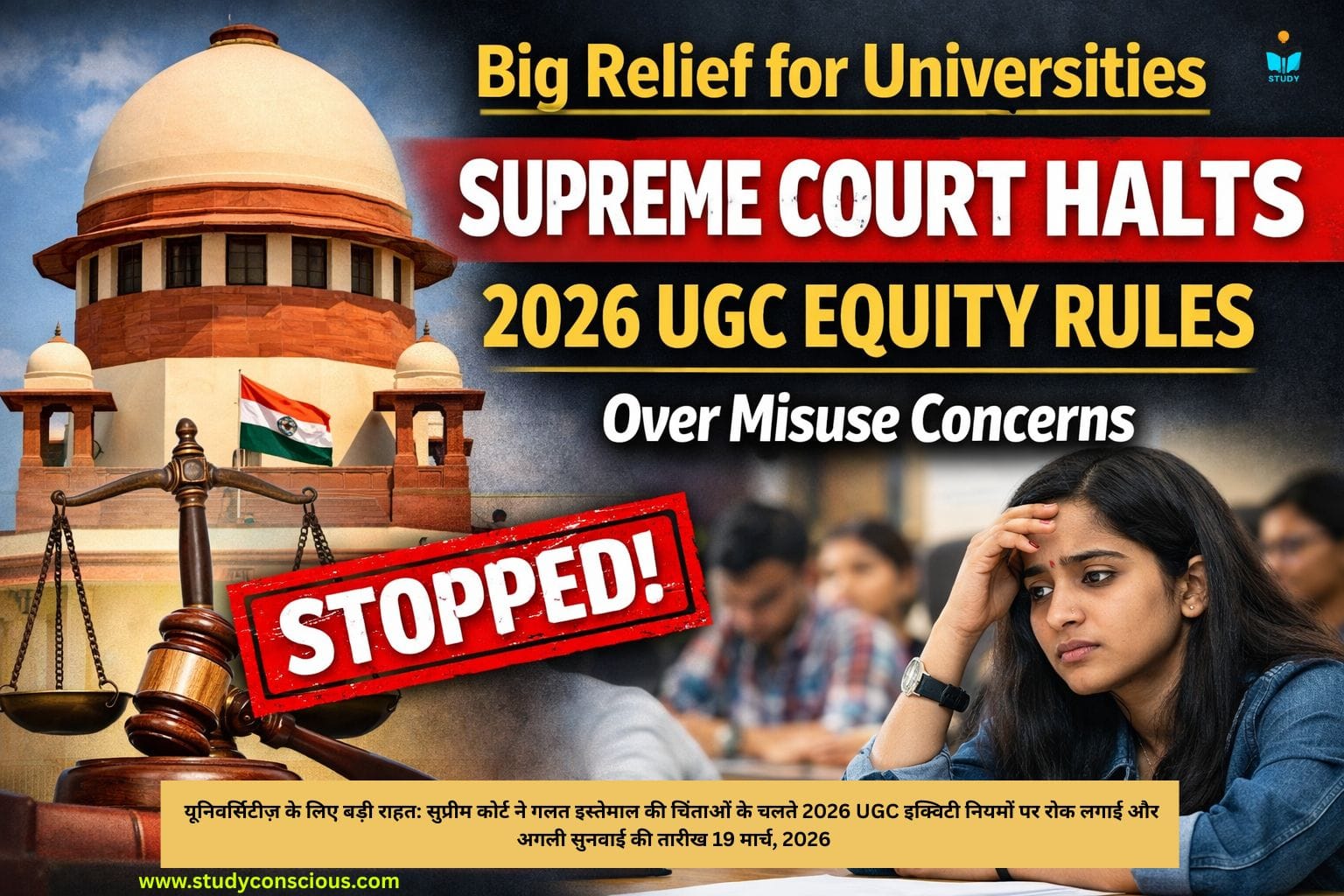
The Indian higher education ecosystem is currently going through a significant debate as the proposed Equity Rules 2026 under the University Grants Commission (UGC) are facing legal challenges, and the Supreme Court of India has stayed the implementation of the rules based on the concerns that certain provisions are ambiguous and prone to abuse.
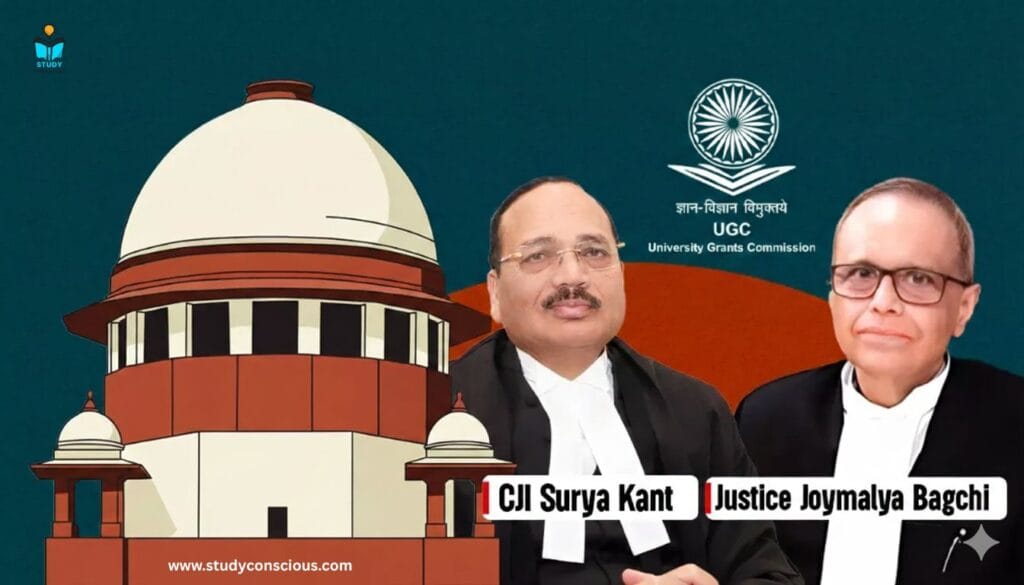
Bench : CJI Surya Kant and J Joymalya Bagchi.
भारतीय हायर एजुकेशन इकोसिस्टम इस समय एक बड़ी बहस से गुज़र रहा है क्योंकि यूनिवर्सिटी ग्रांट्स कमीशन (UGC) के तहत प्रस्तावित इक्विटी रूल्स 2026 को कानूनी चुनौतियों का सामना करना पड़ रहा है, और भारत के सुप्रीम कोर्ट ने इस चिंता के आधार पर नियमों को लागू करने पर रोक लगा दी है कि कुछ नियम साफ़ नहीं हैं और उनका गलत इस्तेमाल हो सकता है।
The next hearing date in the Supreme Court of India for the new UGC regulations (concerning equality in higher educational institutions) is set for March 19, 2026.
नए UGC रेगुलेशंस (हायर एजुकेशनल इंस्टीट्यूशन्स में बराबरी से जुड़े) के लिए सुप्रीम कोर्ट में अगली सुनवाई की तारीख 19 मार्च, 2026 तय की गई है।
The Court has temporarily stayed the new 2026 equality regulations. Until a final decision is made, the old 2012 regulations will be in force.
कोर्ट ने नए 2026 के बराबरी रेगुलेशंस पर कुछ समय के लिए रोक लगा दी है। जब तक कोई आखिरी फैसला नहीं हो जाता, तब तक पुराने 2012 के रेगुलेशंस लागू रहेंगे।
1️⃣ What Are the Equity Rules 2026?
The proposed Equity Rules 2026 aim to strengthen inclusion and fairness in India’s higher education system. These rules are said to focus on:
- Expanding access for marginalized communities
- Ensuring institutional accountability
- Framing anti-discrimination guidelines
- Promoting diversity in admissions and faculty recruitment
The goal is to align higher education policies with broader social justice principles.
However, critics argue that certain definitions and enforcement mechanisms lack clarity.
2️⃣ Equity vs Equality – What’s the Difference?
This debate is largely centered on one key concept: Equity vs Equality.
🔹 Equality
Equality means treating everyone the same.
Example: Giving all students the same exam conditions.
🔹 Equity
Equity means providing support based on individual needs.
Example: Extra assistance for students from disadvantaged backgrounds.
Supporters of the policy say equity ensures fair opportunity.
Opponents say poorly defined equity measures can lead to subjective implementation.
3️⃣ Why Did the Supreme Court Intervene?
The Supreme Court of India reportedly observed that:
- Some provisions were too broad
- Language in the rules was ambiguous
- There was potential for arbitrary interpretation
- Institutions could face inconsistent enforcement
Because of this, the court stayed the rules temporarily until further clarification.
This does not mean equity policies are unconstitutional.
It means the drafting must be precise and legally sound.
4️⃣ Impact on Indian Education System
The Indian higher education system, regulated by the University Grants Commission, includes:
- Central universities
- State universities
- Private institutions
- Deemed universities
If implemented in their current form, the Equity Rules could affect:
- Admission policies
- Faculty recruitment norms
- Reservation and inclusion frameworks
- Institutional audits
The stay creates temporary uncertainty but also opens the door for revisions.
5️⃣ Student Reservation Debate & Social Justice Angle
The issue has revived discussions around:
- Reservation policies
- Minority rights in education
- Institutional autonomy
- Balance between inclusion and merit
Supporters argue stronger equity rules are essential for social justice in India.
Critics worry about overregulation and policy misuse.
This debate is not new — it reflects the ongoing evolution of the Indian education policy framework.
6️⃣ What Happens Next?
- The court will hear further arguments.
- The UGC may revise the language.
- Stakeholders (universities, students, legal experts) will submit feedback.
- Final implementation may include amendments.
Until then, the status quo remains.
📌 Why This Matters
Higher education policy directly impacts:
- Millions of students
- Faculty careers
- Institutional autonomy
- Social mobility in India
The final outcome of the Equity Rules 2026 will shape the future direction of higher education reforms in the country.
Our Recent Blogs:
Will Russia and China act as mediators on Kashmir? Learn about India’s likely response || क्या कश्मीर पर रूस-चीन बनेंगे ‘मीडिएटर’? जानिए भारत की संभावित प्रतिक्रिया
Ind vs Pak T20 World Cup 2026: India Hammer Pakistan by 61 Runs
https://studyconscious.com/sarvam-ai-explained-indias-chatgpt-like-ai/
BNP’s Big Victory in Bangladesh: PM Modi Talks to Tarique Rahman, Calls for Peace and Progress
PM Modi Inaugurates New PMO ‘Seva Teerth’, Begins Work with Big Policy Decisions
#EducationNewsIndia #HigherEducation #EducationPolicy #CurrentAffairs #AnkitSir #IndianStudents #BreakingNews #ankitavasthisir #BreakingNews #hindinewsheadlines #ViralNews #TrendingNow #HindiNews #BreakingNewsIndia #ankitsir #news #trendingvideos #latestnews #ankitinspiresindia #hindinews #currentaffairs #apnipathshala #rna #realnewsanalysis #ankitawasthisir #GlobalConflict #AnkitSirClips










Bahut sahi hai ye fayeshla abhi kuchh din pahle hi bihar ke darbangha ke gaw me 210 bramhano pe sc- st ke tahat kesh dal diya gaya jab ki kuchh un 210 logo me se kuchh waha rahte bhi nhi hai.